Form check
Lunge form check: depth, trunk and both legs.
A lunge is a squat on one leg with a balance problem attached. A coach watches two things and compares a third: how far the front knee bends, whether the trunk stays tall, and whether the left leg matches the right. Here is each one, with the words the coach in Loopform AI says when it sees it.
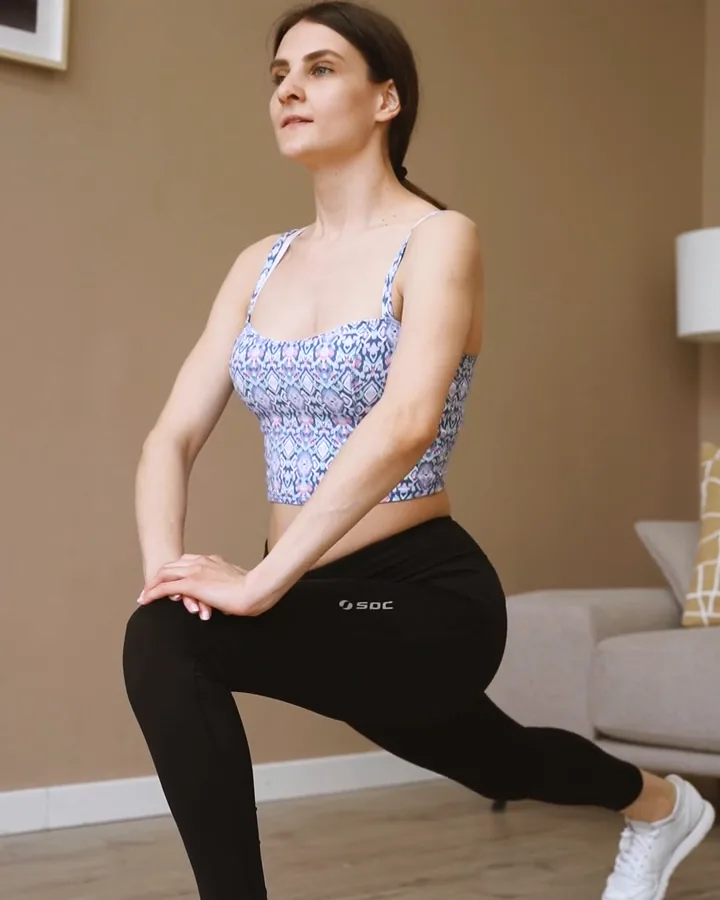
What a good rep looks like
- Depth. The front knee bends to about ninety degrees and the back knee drops toward the floor. The camera reads the front knee angle; near ninety is the standard, deeper is fine.
- Trunk. Tall, with a slight forward lean at most. Folding forward turns a leg exercise into a balance exercise and loads the front knee.
- Front knee. Tracks over the foot, not inside it, and the front heel stays down.
- Both legs. Whatever you do on the left, do on the right. The gap between them is the most useful thing a lunge tells you.
The faults and what the coach says
Shallow depth
The front knee stopped well short of ninety degrees and the back knee stayed high. Usually a stride that is too short, or a fear of the back knee touching down. Lengthen the step a little and let the back knee come close to the floor; it is allowed to kiss it.
The coach says: "Drop the back knee lower." · "Little deeper, let that back knee kiss the floor." · "That one was shallow. Sink into it." · "Front knee to 90, back knee down."
Tipping forward
The trunk leans past the lunge's tolerance at the bottom, or changes angle a lot between the top and the bottom of the same rep. Brace before you step, keep the eyes level, and drive up through the front heel rather than pushing off the toes.
The coach says: "Stay tall through the torso." · "Chest up, eyes forward." · "You're tipping forward. Upright on this one."
One leg doing more than the other
Not a cue mid-set, but the thing to look at afterwards. If one side is consistently shallower or the same leg keeps leading, that side is weaker or stiffer, and it is the side to start on next time.
How to check yourself
- Phone at knee height, 6 to 8 feet back, side-on, with room to step forward and stay in frame. The filming guide has the rest.
- Pause at the bottom of a left rep and a right rep. Compare the front knee angle and the trunk. The difference is your homework.
- Watch the front heel. If it lifts, the step is too short.
Variations the same rules cover
Forward lunge, reverse lunge, walking lunge, split squat. A reverse lunge is the easiest on the knees and the best place to start. On a split squat the stance never closes, so the "top" is simply the tallest point of the rep. The coach handles each of these and attributes every rep to the leg that led it.
How Loopform AI coaches it
Side-on to the phone, with room to step, the coach reads which leg is in front from your feet, counts each rep on that leg, judges depth from the front knee angle, and watches the trunk at the bottom. It keeps separate counts for left and right so you can see the gap, and says one cue per rep, out loud.
Rep counting and form cues are free, with or without a subscription. Video never leaves your phone unless you share a clip. Android arrives in January.